Unified AI API Tips for Optimizing Your Business Performance?
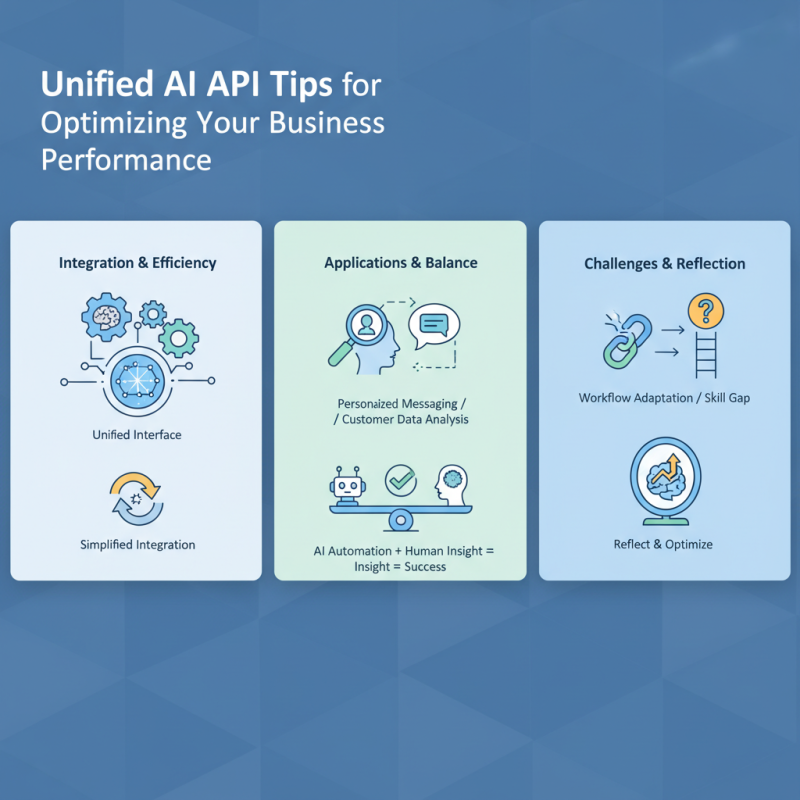
In today's fast-paced digital landscape, businesses must leverage every tool available to stay competitive. The Unified AI API stands out as a game changer for organizations aiming to boost their performance. This technology consolidates various AI functions into a single interface. It simplifies integration and enhances efficiency.
Imagine a marketing team using the Unified AI API to analyze customer data more effectively. They can craft personalized messages that drive engagement. However, relying solely on this technology can lead to over-automation. It's important to balance AI automation with human insight.
Moreover, some organizations may struggle to adapt existing workflows to incorporate the Unified AI API seamlessly. Not every team is equipped with the necessary technical skills. These challenges can diminish the potential benefits and hinder business performance. Reflecting on these aspects will help organizations make the most of this advanced solution.
Understanding Unified AI APIs and Their Role in Business Optimization
Unified AI APIs are transforming the way businesses operate. These powerful tools facilitate seamless integration of artificial intelligence into existing systems. Companies can leverage them to automate tasks, analyze data, and enhance customer experiences. For instance, a small retail business could use an AI API to track inventory in real-time. This minimizes the risk of stockouts and lost sales.
However, not every implementation is perfect. Many companies struggle with data quality and integration challenges. Sometimes, the chosen API may not fit well with legacy systems. It is crucial to evaluate compatibility before selection.
Testing and iterating on these APIs can reveal unforeseen issues. Understanding your business needs deeply is essential to avoid missteps.
APIs can provide insights derived from data analytics. These insights help businesses make informed decisions. Yet, if the data fed into the API is flawed, the insights will also be unreliable. Organizations must adopt a systematic approach to data collection and management. Balancing these aspects can lead to greater efficiency and improved performance.
Identifying Key Performance Metrics Influenced by Unified AI APIs
Unified AI APIs have the potential to drastically enhance business performance by providing actionable insights. Identifying key performance metrics is crucial. A recent report by McKinsey suggests that organizations leveraging AI can improve their operational efficiency by 30%. This shows the massive impact AI technologies can have on performance metrics.
One critical area influenced by Unified AI APIs is customer satisfaction. According to a study by Harvard Business Review, 65% of consumers are willing to pay more for a better experience. This underscores the need for businesses to measure customer feedback effectively. Unified AI APIs can help in real-time analysis. By interpreting sentiment analysis from social media or feedback forms, businesses can gain sharper insights.
Another key metric is employee productivity. A report from Deloitte indicates that companies that integrate AI into their workflows see an average productivity increase of 20%. However, this doesn’t always translate into a smooth implementation. Many organizations face challenges in data integration and training staff. These issues can hinder the overall effectiveness of AI solutions. Reflection on these barriers is necessary for understanding how to optimize performance fully.
Unified AI API Tips for Optimizing Your Business Performance
| Key Performance Metric | Before AI Integration | After AI Integration | Percentage Improvement |
| Sales Revenue | $250,000 | $350,000 | 40% |
| Customer Retention Rate | 70% | 85% | 21.43% |
| Employee Productivity | 120 hours/month | 150 hours/month | 25% |
| Marketing ROI | 200% | 300% | 50% |
| Product Returns | 15% | 8% | 46.67% |
Strategies for Integrating Unified AI APIs into Existing Business Systems
Integrating unified AI APIs into existing business systems can enhance efficiency and streamline operations. A recent report indicates that organizations utilizing AI show a productivity increase of up to 40%. This impressive figure highlights the importance of leveraging advanced technology. However, merely adopting AI does not guarantee success. Many companies face integration challenges that can hinder performance.
To address these issues, businesses should evaluate their current systems. It’s essential to identify compatibility gaps before implementing AI solutions. Although 70% of organizations plan to integrate AI, about 50%% struggle with data silos and legacy systems. This indicates a clear need for strategic planning. Training staff on the new systems can also be overlooked. Inadequate training can lead to misplaced expectations and poor utilization of AI capabilities.
Ensuring a seamless integration requires a step-by-step approach. Focus on incremental improvements rather than a complete overhaul. This allows teams to adjust and adapt gradually, minimizing disruption. While AI promises high returns, real benefits are realized only through thoughtful execution. Listening to employee feedback during the process is crucial, as it can reveal unforeseen challenges.
Best Practices for Maximizing Efficiency with Unified AI APIs
Unified AI APIs are transforming how businesses operate. These tools streamline processes and improve decision-making. According to a recent industry report, companies using AI APIs see a 30% increase in operational efficiency. This statistic highlights the potential gains when effectively integrated.
To optimize performance, it's essential to align AI capabilities with business goals. Often, companies neglect to assess their unique needs before implementation. Customization is key. Generic solutions may fall short, leading to wasted resources. By only applying relevant features, businesses can avoid complications and maximize ROI.
Data integration is another crucial aspect. Inconsistent data can cause errors and misinformed decisions. A study suggests that 25% of business leaders report data silos as a major hurdle. Companies must ensure seamless communication between systems. This unification promotes better insights and fosters collaboration. Emphasizing these best practices can help mitigate risks associated with technology adoption.
Case Studies: Successful Business Transformations Using Unified AI APIs
Unified AI APIs have transformed various businesses, showcasing their potential through several case studies. For instance, one company modernized its customer service using these APIs. They integrated chatbots powered by AI to handle common queries. This helped reduce response times significantly, but some customers felt the interaction was too robotic. Balancing automation and a personal touch remains a challenge.
Another example involves optimizing supply chain management. A retail company leveraged AI APIs to analyze inventory data. They improved stock levels and reduced waste, yet they faced hurdles with data accuracy. The reliance on technology meant that occasional glitches disrupted operations. It highlights the importance of continuous monitoring and adjustments.
Investing in Unified AI APIs can drive impressive results. However, it's not without its flaws. Many organizations initially struggle to implement these systems effectively. They often overlook employee training and change management. Recognizing these challenges is key to a successful transformation. Understanding the highs and lows of AI deployment will better prepare businesses for the future.
Impact of Unified AI API on Business Performance
